

The Year I Pressed Reset: 10 Leadership Trends For 2026, from a Year of Deep Learning and Reinvention

In a world where markets shift overnight and technology rewrites long-held rules, leaders often feel compelled to keep running—to deliver more, scale faster, and stay ahead. Yet the most transformative year in my two-decade career came from doing something counterintuitive: pausing intentionally to learn.
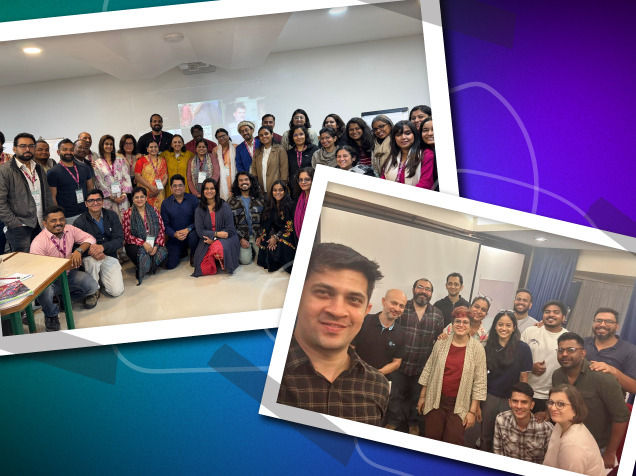
This year, I leaned into structured learning across global business strategy, social sector leadership, design academia, and AI-driven transformation.From the Stanford Seed Transformation Program done by our CEO for Therefore, to the ILSS Fundraising Leadership Program, to serving twice as a jury member at the National Institute of Design, to leading our organisation through a rigorous year of AI adoption—every experience reshaped what effective leadership must look like today.
What emerged are 10 timeless lessons that any business leader—across sectors, across contexts—can apply to remain relevant, resilient, and future-ready.

Focus Is a Growth Strategy
Growth accelerates not when we do more, but when we do the right things deeply.
The Stanford Seed curriculum reinforced that organisations often grow fastest when they narrow their scope.Mastery of craft, clarity of niche, and deliberate positioning create strategic momentum that scattered effort never can.
Focus is not a constraint—it is a multiplier.
Trend Insight for 2026: With category fragmentation and micro-brand explosions in emerging markets, hyper-specialisation is becoming a winning moat as consumers seek experts over generalists.

Stanford drove home the value of structured thinking—frameworks, segmentation models, strategy layers. These tools are not academic exercises; they are decision scaffolds. When strategy becomes structured, teams align quicker, execution sharpens, and growth becomes repeatable.
Trend Insight for 2026: As data abundance reaches a peak, companies that operationalise clarity through structured decision-making models will outperform those drowning in information noise.

Change Thrives When Teams Lead It
Transformation is strongest when it is built from within, not broadcast from above.
Whether in Stanford’s leadership modules or in coaching our own teams, the pattern was clear:Empowered teams drive sustainable change.When team members are trusted with ownership, questioning, and decision-making, the organisation builds adaptability from the inside out.
Trend Insight for 2026: Global workforce studies show surging preference for decentralised, pod-based, and co-ownership models—making collaborative power-teams the new engines of transformation

Rigour Is the Most Underrated Driver of Success
Inspiration starts the journey. Rigour completes it.
The ILSS Fundraising Leadership Program was a powerful reminder that nothing substitutes disciplined execution.Documentation, review cadences, weekly goals, feedback loops—these are the quiet engines that transform aspiration into result.
Rigour creates reliability in systems that must grow.
Trend Insight for 2026: In a market fatigued by hype cycles, organisations with disciplined operating systems—OKRs, review rhythms, documentation—are proving far more resilient during volatility.

Leaders Must Learn to Dream at Scale
Vision is not limited by reality. It is limited by imagination.
One of the biggest takeaways from ILSS was the need for bolder thinking.Many organisations dream small because constraints feel heavy. But when leaders think expansively, possibilities widen and collaborators step in.
Dreams set direction. Systems make them real.
Trend Insight for 2026: Investors and global partners increasingly back organisations with bold, future-facing visions as capital shifts toward mission-led and moonshot-thinking ventures.

This year, some of the deepest lessons came from peers—Stanford cohort members, nonprofit leaders at ILSS, design faculty at NID. Exchanging perspectives with leaders outside your industry reveals blind spots that internal circles cannot.
Peer learning multiplies perspective at remarkable speed.
Trend Insight for 2026: Curated peer networks are becoming the fastest-growing form of professional development, replacing traditional top-down leadership training formats.

Creativity Still Begins With the Hands
Breakthrough ideas still start with a pencil, not a software.
Evaluating student work at NID was a reminder that tactile exploration sparks originality.Sketching, prototyping, and hands-on experimentation activate a depth of thinking that digital shortcuts simply cannot replicate.
Making precedes meaning.
Trend Insight for 2026: As AI-generated sameness increases, handmade and analog-first creative processes are gaining renewed value, especially in premium, craft-led, and cultural sectors.

Design Is a Strategic Lever, Not an Aesthetic Layer
Design today shapes systems, not just screens or prints.
Watching young designers tackle systemic, behavioural, and experiential challenges reaffirmed that design has expanded far beyond visuals. For business leaders, recognising design as a strategic capability—not a post-production activity—creates an innovation advantage.
Design is structure, behavior, and business thinking.
Trend Insight for 2026: Organisations are investing in design as a systems capability—service design, behaviour design, and systems design are becoming core to growth strategy, not optional layers.

Our organisation’s AI adoption journey began in chaos—contradictory tools, unclear value, overwhelming noise.The breakthrough came when we treated AI the way we treat strategy or research:sift, evaluate, test, refine, repeat.
The reward goes to those who curate, not those who collect tools.
Trend Insight for 2026: The competitive edge now lies in AI governance, tool curation, and adoption roadmaps—companies that curate intentionally will outperform those that simply integrate quickly.

Adaptability Has Become the New Leadership Currency
In a world of shifting ground, adaptability outperforms expertise.
AI also taught us an unexpected lesson: leaders don’t need to know every new tool—they need to enable their teams to experiment, learn, and own the solutions.Comfort with uncertainty, openness to new methods, and agility in decision-making have become core competencies.
Those who adapt fastest, win longest.
Trend Insight for 2026: With the half-life of skills shrinking rapidly, adaptability is emerging as the single most valued leadership trait across global hiring and succession frameworks.
The Larger Realisation: Learning Is Leadership
Reinvention is not an event.
It is a leadership habit.
Across the Stanford classrooms, ILSS cohorts, design jury rooms, and AI implementation trenches, the through-line was unmistakable:Lifelong learning is no longer a personal choice. It is a strategic responsibility.
The leaders who thrive will be the ones who:
Stay curious
Build structures of rigour
Empower teams
Invite experimentation
And reinvent their thinking repeatedly
As the year ends, the biggest clarity that emerges is this:The future will belong to leaders who learn faster than the world changes.
And for those willing to pause, reflect, and rebuild—the next era of innovation is already within reach.


Comments