

The Uncomfortable Weight of Choosing: When Empathy and Excellence Collide

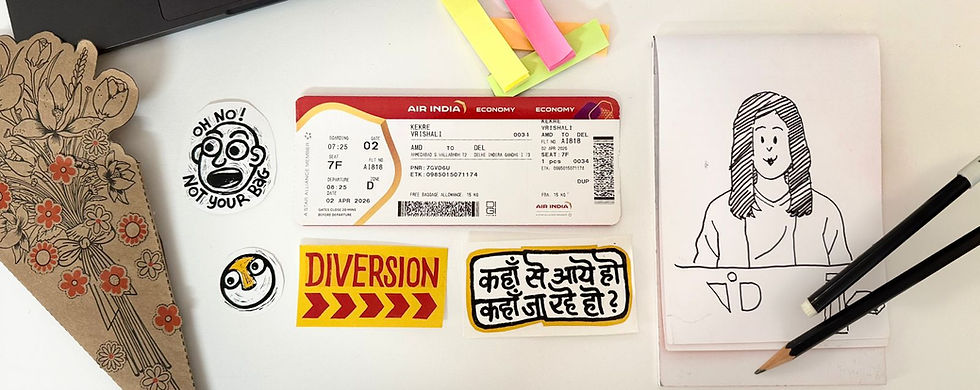
Frugal bouquet & rapid sketch by a student candidate, stickers as a token of love from Tarundg, Tickets curtesy NID travel desk and admission cell
There are some weeks that don’t just exhaust you—they rearrange you a little.
I came back from six days of sitting on the interview panel for the M.Des Graphic Design program at National Institute of Design, and I haven’t quite been able to switch off since. Not in the way one recovers from long workdays or travel fatigue. This was different. This was the kind of tired that lingers behind your eyes and quietly follows you into the night.
Because every single candidate was not just a portfolio. They were a question.
And not the easy kind.
Each day, we sat across from students who had already made it through a brutal filtering process. When you’re looking at the top 2.2%, you are not choosing between good and bad. You are choosing between good and… differently good. And somewhere in that spectrum lies a deeply uncomfortable tension: do you choose the one who can, or the one who will?
The one who breezes through, or the one who has crawled here on their knees?
I kept circling the same dilemma: is excellence about raw, visible skill—or about hunger, resilience, and the kind of quiet fire that doesn’t always show up neatly in a portfolio?
And more dangerously—what role does empathy play in that decision?
Designers, almost by definition, are wired for empathy. We are trained to step into other people’s shoes, to understand context, to look beyond what is visible. Tim Brown famously said that “design thinking begins with empathy.” It’s practically our operating system.
But what happens when empathy starts interfering with judgment?
Because it does.
You see a candidate who has attempted this three times. You hear their story—small town, limited access, learning design off patchy internet connections and borrowed laptops. You can almost map their journey in the rough edges of their work. And suddenly, you’re not just evaluating typography or layout or conceptual clarity. You’re evaluating effort. Grit. Desire.
You want to root for them. You do root for them.
And then the next candidate walks in. Effortless.. talented ... The kind of work that makes you sit up a little straighter. They have practiced and worked hard ..but they haven’t struggled in the same visible way. Their journey isn’t as dramatic. But the output? Undeniably stronger.
Now what?
Do you reward the struggle or the outcome?
Somewhere in the back of my mind, I could hear Malcolm Gladwell whispering about the 10,000-hour rule, about how mastery is built, not born. And yet, right alongside that, there’s Pablo Picasso, who once said, “It took me four years to paint like Raphael, but a lifetime to paint like a child.” Talent and effort are not opposites. They are entangled. Messy.
But interview panels don’t have the luxury of philosophical indulgence. You have a seat to fill.
And so the questions become sharper, almost uncomfortable in their honesty: Should we select the most skilled candidate? Or the one who will value this opportunity the most? Should persistence outweigh natural ability? Does ease signal depth—or just access?
At some point, I caught myself wondering whether empathy, in this context, is not a strength but a bias. A beautiful human bias... but a bias nonetheless.
Because empathy makes you feel the stakes differently. It makes you imagine futures. It makes you weigh not just what is, but what could be. It nudges you to think about impact—not just on the institution, but on the individual, their family, their community.
Who needs this seat more? It’s a dangerous question. Because “need” is not a standard metric of excellence. But it refuses to stay out of the room.
And then comes the uncomfortable counterpoint: should an institutions be in the business of transformation—or selection? Should it pick diamonds, or should it pick carbon? There’s a quiet assumption in education that given the right environment, anyone can be shaped into excellence. But is that entirely true? Or is there a threshold of readiness, of aptitude, that cannot be bypassed no matter how much empathy you bring into the equation?
I don’t have answers. I only have more questions.
What made it harder was that this wasn’t an abstract exercise. These were real young people, sitting across from us, trying to hold themselves together in high-stakes conversations. You could see the rehearsed answers, the nervous pauses, the flashes of brilliance, the moments of collapse.
And every evening, as I walked back to the guesthouse, past the wide green lawns, watching students unwind with frisbee as the city cooled off, the questions followed me and I found myself drawing uncomfortable parallels with my own work at Therefore Design. Hiring decisions... Team building... Have I been doing the same thing?
Am I subconsciously choosing people who need the job more than those who are objectively better at it? Am I mistaking gratitude for capability? Am I over-indexing on attitude because it feels more human, more fair, more… kind? And more importantly—are these trade-offs even real?
Because another part of me argues that someone who values an opportunity deeply will, by default, put in the work to excel. That hunger translates into performance. That the underdog story is not just emotionally satisfying but often true. But is that always the case?Or am I selectively remembering the success stories because they validate my bias?
Angela Duckworth talks about “grit” as a predictor of success—passion and perseverance over long periods of time. It’s compelling. It aligns beautifully with the idea of backing the person who refuses to give up.
And yet, in high-performance environments, raw competence matters. Deeply.
You can’t entirely train instinct. You can’t manufacture taste overnight. You can’t always bridge the gap between “almost there” and “exceptional” through effort alone.
So where does that leave empathy?
Is it a necessary lens—or a distorting one?
Somewhere between interviews, panel discussion, coffee chats and late-night overthinking, I realised that what makes this so difficult is not the lack of criteria—but the abundance of them. Skill. Potential. Learnability. Curiosity. Groundedness. Communication. Resilience. Context. And then, layered over all of it, empathy.
It’s not that empathy replaces excellence. It just refuses to sit quietly beside it.
And maybe that’s the point.
Because removing empathy entirely would make the process cleaner—but also colder. More efficient, perhaps—but less human. You could reduce everything to scores, rubrics, weighted averages. You could, theoretically, automate it.
Which brings me to the part that amused me the most.
Somewhere between conversations with fellow panelists—spanning design, education, and inevitably, AI—I found myself smiling at the absurdity of it all. We spoke about algorithms, about generative tools, about how systems are getting better at evaluating patterns and outputs..and how design landscapes are changing.
And I thought: how on earth would AI sit in that room?
How would it process the hesitation in a candidate’s voice? The context behind a rough portfolio? The invisible weight of someone’s journey?.. Could it quantify “need”? Should it?... And more uncomfortably—should we?
Because even as I resist the idea of AI replacing such decisions, I can’t ignore the irony. The very confusion I am experiencing—the emotional overload, the inability to arrive at a clean answer—is precisely what makes us human… and possibly, what makes us inconsistent.
Maybe even unfair.
And yet, I’m not sure I would trade that away.
On my last night there, walking back a little slower than usual, I realised that the real conflict is not between empathy and excellence. It’s between two different definitions of fairness. Fairness as merit. Fairness as opportunity. Both feel right. Both feel necessary. And both, inconveniently, don’t always point to the same person.
I wish I could say I’ve resolved this. That I’ve come back with a clearer framework, a sharper instinct, a more confident approach. But the truth is, I’ve come back with a slightly heavier mind. And perhaps a softer one too.
I still don’t know whether empathy is holding me back—or holding something else together.
I don’t know if I should lean into it or guard against it.
I don’t know whether the best decision is the one that looks right on paper—or the one that feels right in your gut.
What I do know is that the next time I sit across from a candidate- whether at NID or across the table at Therefore Design—I will be carrying all of this with me.
The questions. The contradictions. The quiet tug-of-war between heart and head.
And maybe that’s unavoidable.
Maybe the discomfort is not a flaw in the process - but the process itself.
Maybe choosing well is not about eliminating bias - but about being aware of it, even as it quietly shapes your decisions.
Or maybe I’m just overthinking it.
Either way, I suspect this is not a question that will leave me anytime soon.
Disclaimer: The reflections shared here are entirely my own, drawn from personal experience and introspection. They do not represent the views, policies, or positions of the National Institute of Design or any other Panellist I was associated with during the process.


Comments